

Aritech DDV1016AM-N - 16 m, Dual Vector, 9 curtains, anti-mask, digital pyro, neural algorithm
| Couleur: Blanc |
| Marque: Aritech |
| Environnement: Intérieur |
| Filaire / sans fil: Filaire |
| Montage: Mural |
| Technologie de détection: Double technologie |
| Anti-masquage: Oui |
| Immunité animaux: Non |
Patented technologies: range gated radar and neural algorithm
Motion sensors of the DD1000 Series incorporate a Carrier Fire & Security patented and unique range gated radar technology allowing the installer to define a clear borderline of the radar range as the radar is used to measure distance between the sensor and moving objects. Effectively the end-user will get rid of any nuisance alarms generated by movements outside the detection pattern. Every motion sensor comes with 4 possible radar ranges selectable via dip switches allowing the detection pattern to be tailored according to the room where the motion sensor is installed. The radar operates on 5.8 GHz frequency.
The DDV1016AM-N motion sensor incorporates a new digital pyro and a brand new algorithm to filter out unwanted alarms. Thanks to these two technologies, a better quality of signals is generated. The advanced processing combined with a better detection performance result in an extreme low rate of unwanted alarms.
PIR technology in combination with patented mirror optics
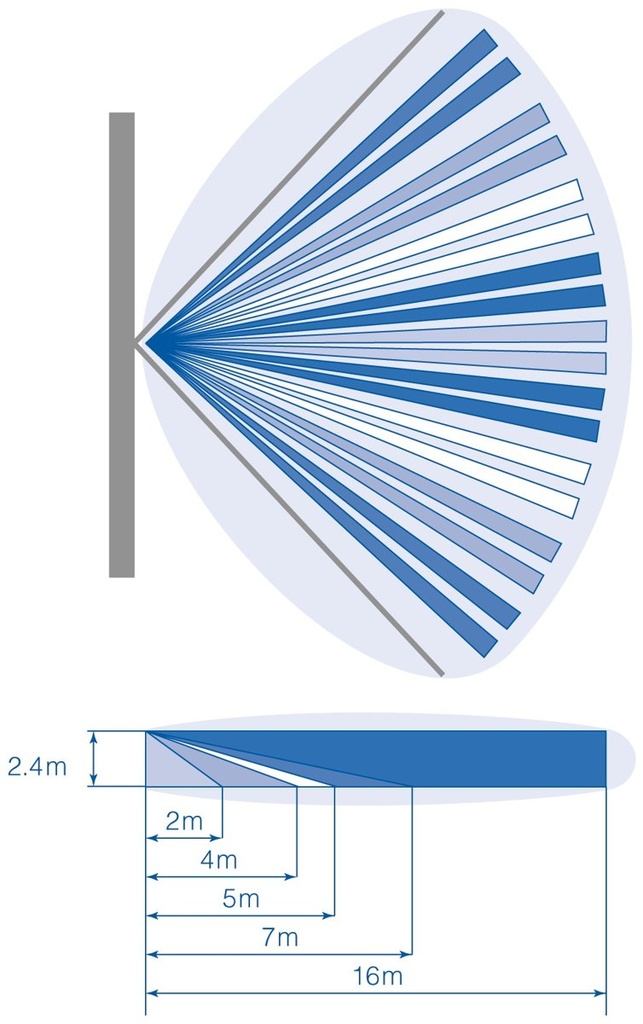
Our patented optical mirror technology gives the advantage of gliding focus, which creates a continuous detection curtain from floor level up to installation height. Using a four element pyro, so generating 4 volumetric curtains for each of the 9 curtain sets, in combination with our VE-techniques allowed us to create a 16 m dual tech motion sensor in a rather small housing.
Detection technologies working together
These dual tech motion sensors generate an alarm depending on what both technologies – range gated radar and PIR – saw within its detection coverage. But our dual tech go beyond a simple “AND” function : it classifies the signals from each technology – range gated radar and PIR – to have the best alarm result without being sensitive for nuisance signal sources. This technology creates a uniform sensitivity in all course directions.
Ease and flexibility of installation
1. Tolerates wall angle deviation and different mounting heights. 2. Limited loss of coverage when objects are placed in the field of the PIR vision. 3. Easy range setting via dip switches of the range gated radar in order to tailor the detection pattern to your needs. 4. Multiple build-in End-Of-Line resistor values with “easy wiring” option available. 5. Plug-in connector.
Anti-masking (optical and radar)
The use of Active Infrared and radar technology results in a superior anti-masking functionality that supervises the motion sensor on the inside and outside. Radar verification prevents from having unwanted AM alarms caused by e.g. insects. In advanced setting the AM alarm is held until the effective source of the anti-masking (e.g. spray, tape,…) has been removed. Even partial masking – so going beyond the EN Grade III standard – will be detected when in advanced setting.
Other members of the family
The consistent family aesthetics between the various models ensure a professional approach when installing different sensor types.
Neural network-based technology algorithm
Aritech has developed an improved algorithm based on cutting edge neural network-based technology to improve the detection performance and reduce false alarms triggered by external sources. Neural networks are trained to extract complex image features effectively; it allows the detection of slow motion even further apart from the detector. This algorithm has the aim to improve even further the immunity to false alarms, which is a key concern for major applications of sensors in commercial settings.
Key features:
|
Technical specifications:
| ||||||||||||||||||||||||||||||||||||||||||||||||||||||||||||||||||||||||||||||||||||||||
Documentation : Fiche technique (FR) · Notice d'installation (FR) · BIM 3D model (FR) · Fiche technique (EN) · BIM 3D model (EN)