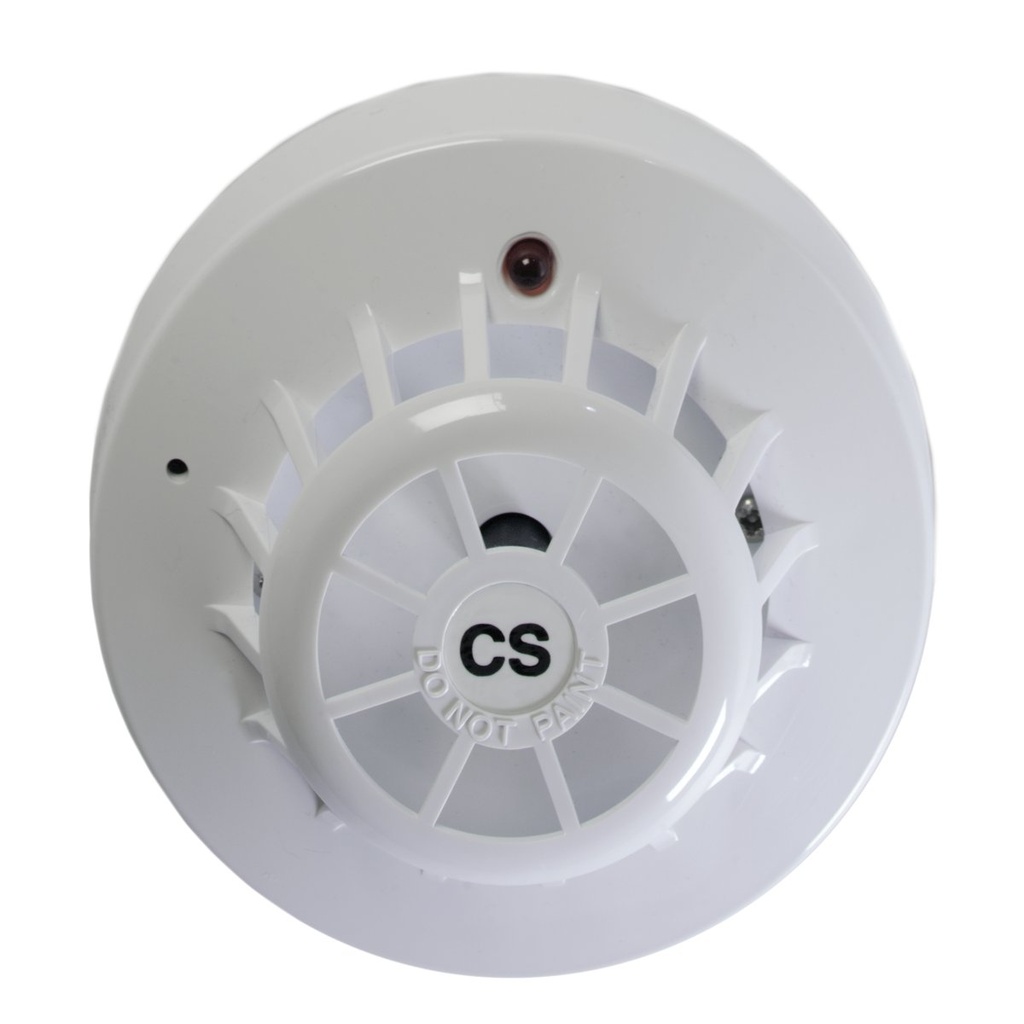
Apollo DT657 - Apollo Series 65 Heat Detector, Class CS (55000-137)
| Couleur: Blanc |
| Marque: Apollo |
| Environnement: Intérieur |
| Type de détecteur: Thermique |
General
The 650 Series conventional detectors are designed for the highest effectiveness utilising the latest technology. A wide operating voltage (9 to 33 VDC) allows them to be used on any security system.
Ionisation Detectors
The detector sensor consists of 2 cambers - an open outer chamber and a semi-sealed reference chamber. As smoke enters the open chamber, the voltage difference between the chambers is measured and compared to a pre-set trigger level for alarm. An integrating ionisation detector, suitable for use in areas where transient levels of smoke may be present, is also available.
Optical Smoke Detectors
These detectors use a pulsing LED and photo diode in an dark optical chamber. In the event of smoke from a fire entering the chamber, the light from the LED is scattered and registered by the photo diode.
Series 650 Heat Detectors
Heat detectors normally use a matched pair of thermistors (one exposed and one sealed) to sense heat. In case of fire, the exposed thermistor's temperture increases rapidly, causing the detector to change into the alarm state becuase of the imbalance. Rate-of-rise algorythms may detect the fire as the temperature increases, but a fixed upper temperture limit will force the detector into alarm if the rate of temperature increase has been too slow. The static only response heat detectors use only one thermistor and changes to the alarm state at a preset temperature.
Standard Base
The base enables detectors to be plugged in without any need for force - particularly useful when fitting to suspended ceilings. The base has a "one way only" fit and are lockable. They contain no electronic parts that could be damaged during installation. The detectors are polarity insensitive and bases are easy to wire with an earth connector.
Key features:
|
Technical specifications:
| ||||||||||||||||||||||||||||||||||||||
Documentation: Fiche technique (FR) · Fiche technique (EN)